Why the choice matters
When your product is oxygen-sensitive, the barrier layer is the most important 5-10 microns in your entire package. Picking the wrong material — or the wrong combination — can cut shelf life in half, trigger customer complaints, or even lead to product recalls. The three most common oxygen-barrier materials in flexible packaging today are EVOH, PVDC, and nylon (PA). They are often mentioned interchangeably, but they behave very differently.
EVOH — the gold standard for oxygen barrier
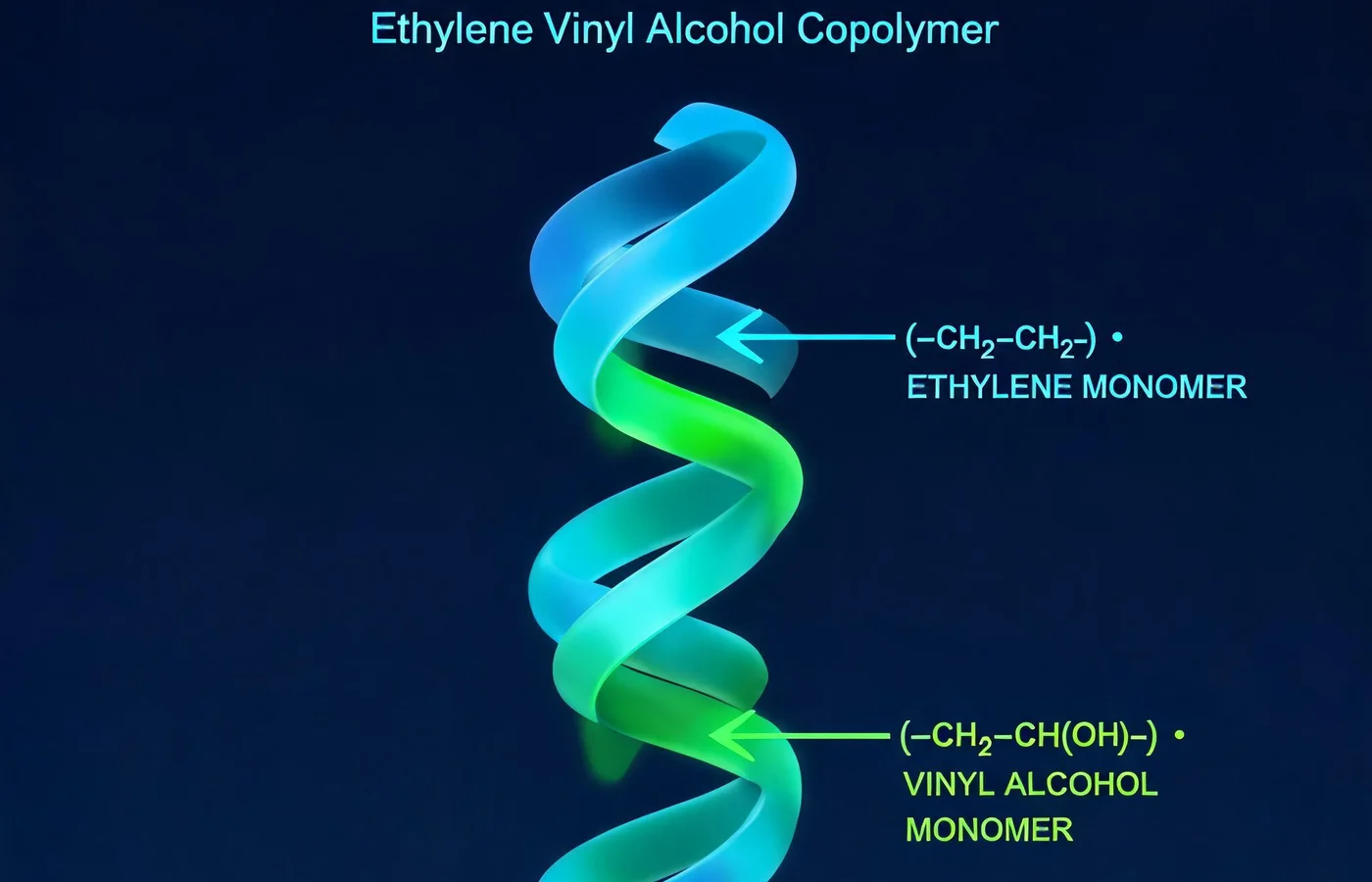
Pros: Highest oxygen barrier of the three (OTR as low as 0.5 cm³/m²·day). Transparent, food-contact approved globally, recyclable in mono-material structures.
Cons: Sensitive to high humidity (mitigated by outer PA layer in most structures). Higher cost than nylon.
Best for: Meat, dairy, ready meals, coffee, pharma — anywhere shelf life is the #1 priority.
PVDC — the moisture-proof veteran
Polyvinylidene chloride has been used in food packaging since the 1950s (think Saran Wrap). It offers both excellent oxygen barrier and excellent moisture barrier, and its performance is much less humidity-dependent than EVOH.
Pros: Outstanding O₂ and H₂O barrier combined. Good in humid conditions. Heat-sealable.
Cons: Contains chlorine — environmental and recycling concerns. Some regions are restricting PVDC. Limited transparency in some grades. Disposal and incineration issues.
Best for: Regions where recycling infrastructure is limited, applications requiring maximum humidity resistance, legacy applications with existing PVDC tooling.
Nylon (PA) — the structural workhorse
Nylon 6 and nylon 6,6 are rarely the primary oxygen barrier, but they are the most common structural layer in barrier films. They provide toughness, puncture resistance, and — importantly — protect EVOH from humidity.
Pros: Excellent mechanical strength, good aroma barrier, moderate O₂ barrier, no chlorine concerns. Compatible with EVOH and PE in co-extrusion.
Cons: Oxygen barrier is roughly 50-100× worse than EVOH at the same thickness. Not suitable as a standalone O₂ barrier for high-sensitivity products.
Best for: Outer layer in PA/EVOH/PE structures, vacuum bag toughness, retort applications.
Side-by-side comparison
| Property | EVOH | PVDC | Nylon (PA) |
|---|---|---|---|
| O₂ barrier (15 μm) | ★★★★★ | ★★★★ | ★★ |
| Moisture barrier | ★★ | ★★★★★ | ★★ |
| Humidity resistance | ★★ | ★★★★★ | ★★★ |
| Mechanical strength | ★★ | ★★ | ★★★★★ |
| Retort suitability | ★★★★ | ★★★ | ★★★★ |
| Recyclability | ★★★★ | ★ | ★★ |
| Regulatory (FDA/EFSA) | ★★★★★ | ★★★★ | ★★★★★ |
| Cost (relative) | Medium-high | Medium | Low-medium |
The bottom line
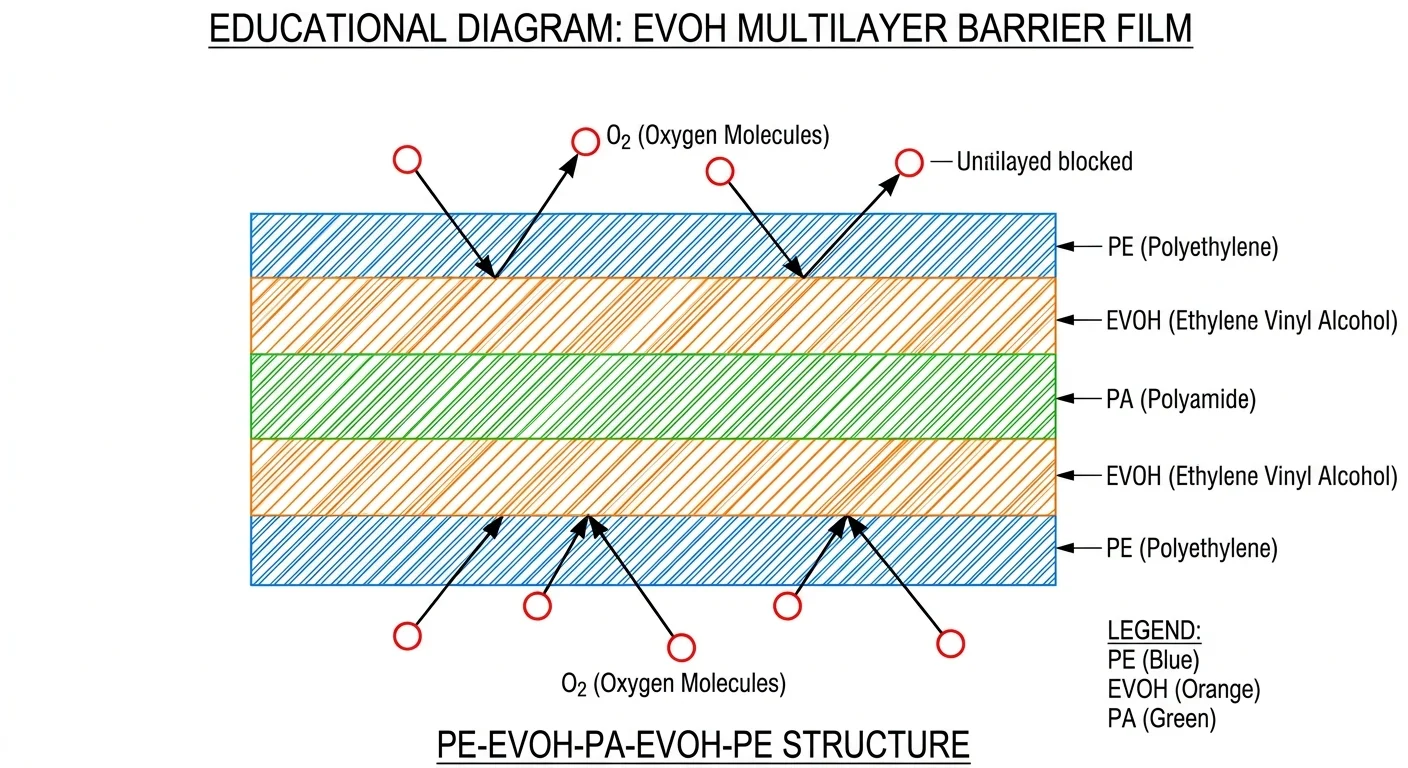
In 90% of modern flexible packaging applications, the answer is EVOH — usually protected by PA. The PA / tie / EVOH / tie / PE structure gives you the best of all three: PA for strength and humidity protection, EVOH for oxygen barrier, PE for sealability and cost. This is the structure we use in most of our co-extrusion films.
PVDC still has a place in specific high-humidity applications, and nylon is rarely used alone as a barrier. For most B2B buyers in Southeast Asia, EVOH-based structures deliver the best combination of performance, compliance, and recyclability.